The Architecture of Caribbean Energy Sovereignty: Nine Technologies and Systems That Can Rewrite Our Energy Destiny

Charlin Bodley
Published on November 25, 2025
The Architecture of Caribbean Energy Sovereignty: Nine Technologies and Systems That Can Rewrite Our Energy Destiny
A Narrative Glimpse of 2035
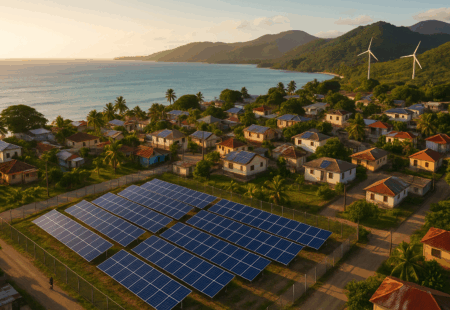
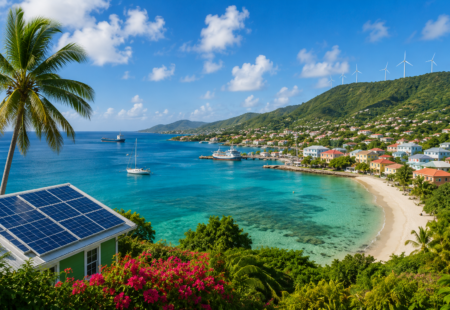
The year is 2035, and at 7:00 am on a weekday the energy system on a Caribbean island is already wide awake. Floating solar fields are ramping up, community batteries are handing the morning load back to the grid, and the geothermal plant has carried the island smoothly through the night. EV buses begin their first routes from solar powered charging depots, while the hydrogen ready ferry at the harbour prepares for its morning departure, its tank filled overnight by geothermal powered electrolyzers.
Across the island, small community microgrids automatically reconnect after routine islanding tests. Most people do not notice. Resilience has become normal.
In the coastal resort strip, ocean cooled loops and centralized cooling plants quietly reduce the day’s peak demand. Hotels participate in automated demand response without disrupting guests. High above, satellite linked AI updates the island’s renewable forecast, adjusting reserve requirements for the utility, the port and the water company in real time.
Meanwhile, the national carbon registry posts yesterday’s avoided emissions from renewable generation, electrified fleets and improved building efficiency. These results feed into a growing portfolio of climate assets the island now trades internationally. More than a decade earlier, Guyana’s forest based credits under the ART TREES mechanism proved that high integrity climate performance from the Caribbean could carry real market value. That early leadership opened the door for today’s integrated regional carbon market, where both forests and advanced energy systems contribute measurable climate outcomes.
Nothing about this morning feels extraordinary. It feels routine, because it is 2035 and this is a typical day on a Caribbean island where energy sovereignty is not aspirational but operational, powered by technologies and systems that until recently felt beyond reach.
A morning like this does not happen by chance. It represents a decade of deliberate investment and technological maturity, where tools once seen as distant or experimental have become part of the region’s everyday infrastructure. They are the engines of a Caribbean energy system built with clarity, purpose and sovereignty.
The 2035 morning imagined above is within reach because of technologies and systems that are already transforming the region. Here are nine that, in my view, will anchor a sovereign Caribbean energy future:
- Floating Solar Systems: Where Land Constraints Meet Ocean Abundance
Most Caribbean islands wrestle with limited land, competing priorities and a lack of land use policies. Floating solar offers a practical alternative. Installed on calm reservoirs, protected bays, and industrial water bodies, these systems optimize space, reduce evaporation, and benefit from natural cooling. In the coming years, floating solar could become a defining feature of Caribbean ports, water utilities, wastewater lagoons and enclosed bays. This would be an ideal example of innovation shaped by our geography rather than constrained by it.
- Ocean Energy Systems: Wave Power and OTEC as the Blue Engine
The Caribbean sits beside one of the planet’s largest untapped resources: the ocean. Advances in modular ocean platforms, mooring technology and deepwater engineering have moved wave energy and OTEC from theoretical concepts to realistic options for island grids. Islands with steep coastal drop-offs and strong thermal gradients are particularly well positioned to integrate ocean energy as a stable source of power that complements intermittent solar generation.
As these ocean-based technologies progress beyond pre commercial stages, they hold the potential to support water security as well. Wave driven desalination and OTEC systems that produce both power and freshwater could prove invaluable for drought prone Caribbean nations. The future Caribbean grid may rely less on land and more on the ocean that surrounds us. It may not be landlocked at all, but rather ocean enabled.
- Digital Grid Intelligence and AI Systems: The Smart Layer Behind Caribbean Sovereignty
High renewable grids require intelligence, not only hardware. In the Caribbean, where weather shifts quickly and grid stability affects every community, digital tools have become as essential as solar panels or batteries. AI powered forecasting, digital twins, real time anomaly detection and advanced DER coordination are now reshaping how our utilities operate.
A major part of this shift is the emergence of virtual power plants. A VPP links solar rooftops, community batteries, EV chargers and smart buildings so they operate like one coordinated power source. Instead of reacting to cloud cover or sudden load changes, the modern Caribbean grid anticipates them and balances reserves, voltage and feeder flows with far greater precision.
For small islands, digital intelligence is not optional. It is the stabilising layer that keeps essential services running, from reliable telecommunications to port logistics and cold storage for food security.
- Community-Scale Storage and Neighbourhood Microgrid Systems
In the Caribbean, resilience is something people live, not something they only plan for. Every community knows which school becomes the hurricane shelter, which clinic must stay powered, and which neighbourhood sits at the end of a vulnerable feeder. Community scale batteries placed at these critical locations turn resilience into a normal part of daily life rather than a response after the fact. Neighbourhood microgrids allow clusters of homes, clinics and small businesses to operate on their own during outages and reconnect smoothly once the main grid is stable. This is resilience built for island realities, centred around communities rather than utility scale fragility.
- Electric Streets and Seas: Integrated Land and Marine E-Mobility Systems
Caribbean mobility depends on short trips, coastal links and movement between islands. Electrifying both land and marine transport is therefore essential to energy security and to the growth of the blue economy. Solar powered EV microhubs located at ports, waterfront areas and village centres will manage charging for public buses, government fleets and rental vehicles. Smart charging systems will shift demand to periods of high renewable generation and help stabilise the grid.
The most significant shift will take place on the water. Marine electric transport, including ferries, harbour craft and small inter island vessels, will cut diesel imports and strengthen trade, tourism and coastal livelihoods. Battery exchange points and hydrogen ready port facilities will support this transition and improve regional connectivity. In this model, mobility is not only about transport. It becomes a driver of the blue economy and a central pillar of Caribbean energy sovereignty.
- Geothermal Energy Systems: Firm Power Meets Future Fuel
The Eastern Caribbean islands possess geothermal potential to power economies, communities, grids and electrolyzers. These islands could be early adopters of geothermal enabled hydrogen, initially for domestic use in ports, fleets and industrial clusters. Hydrogen ready port infrastructure, paired with geothermal stability, quietly positions the Caribbean as a pioneer of firm, clean fuels with export potential on the horizon.
- Deep Cooling Systems: Engineering Comfort for the Caribbean Heat
Although I am not a confident swimmer, my admiration for the ocean’s energy potential is clear, as it appears once again. Cooling is the Caribbean’s largest energy demand, driven by heat, humidity and the heavy use of air conditioning across hotels and public facilities. In this context, the ocean becomes an energy asset.
Seawater cooling loops, centralized cooling plants, thermal storage and AI enabled HVAC optimisation can reduce electricity use by shifting cooling to more efficient systems that draw on colder deep water intakes and smarter load management. The Bahamas has already explored seawater cooling for major hotel and airport facilities, showing strong potential for similar coastal applications across the region.
By adopting ocean supported cooling, islands can lower peak demand, reduce emissions and strengthen resilience while improving comfort in the tourism sector, the region’s most important economic engine.
- Carbon Markets and Climate Commodity Systems: The Caribbean as a Climate Exporter
One of the Caribbean’s most powerful future exports may not be goods, but rather climate outcomes. As carbon markets mature, islands with strong governance and MRV systems can monetize avoided emissions from renewables, electrified fleets and resilience measures. Guyana’s landmark forest carbon agreement proved the principle: Caribbean climate performance can be measured, verified and sold internationally.
With digital carbon registries, satellite monitoring and AI based tracking, carbon becomes a currency that finances energy sovereignty, not metaphorically, but materially.
- Storm-Hardened Infrastructure Systems and Resilience Corridors
For the Caribbean, green infrastructure is not enough. Infrastructure must be engineered for the storms that now define our reality. Hurricanes Irma and Maria, and more recently Hurricane Melissa, showed how quickly traditional grid designs can fail and how costly recovery can become.
The region is now shifting to infrastructure built for Category 5 conditions. Composite poles, underground resilience corridors, flood resistant substations and hurricane rated mounting systems do more than protect the grid. They protect the hospitality corridor, reduce outages and safeguard national economies. In the Caribbean, we do not have the luxury of making resilience optional. It is the baseline for stability and competitiveness.
Closing the circle, from possibility to power
To sum it up, these nine technologies and systems reflect my conviction that the Caribbean can build an energy future that is not only imported but engineered at home. They offer a pathway from a transition that still leaves us dependent to one that places sovereignty at the centre. They are expressions of confidence, capability and regional identity. They signal a Caribbean no longer waiting for solutions but designing them. The future should not happen to the Caribbean. The Caribbean should build it deliberately, intelligently and on its own terms.